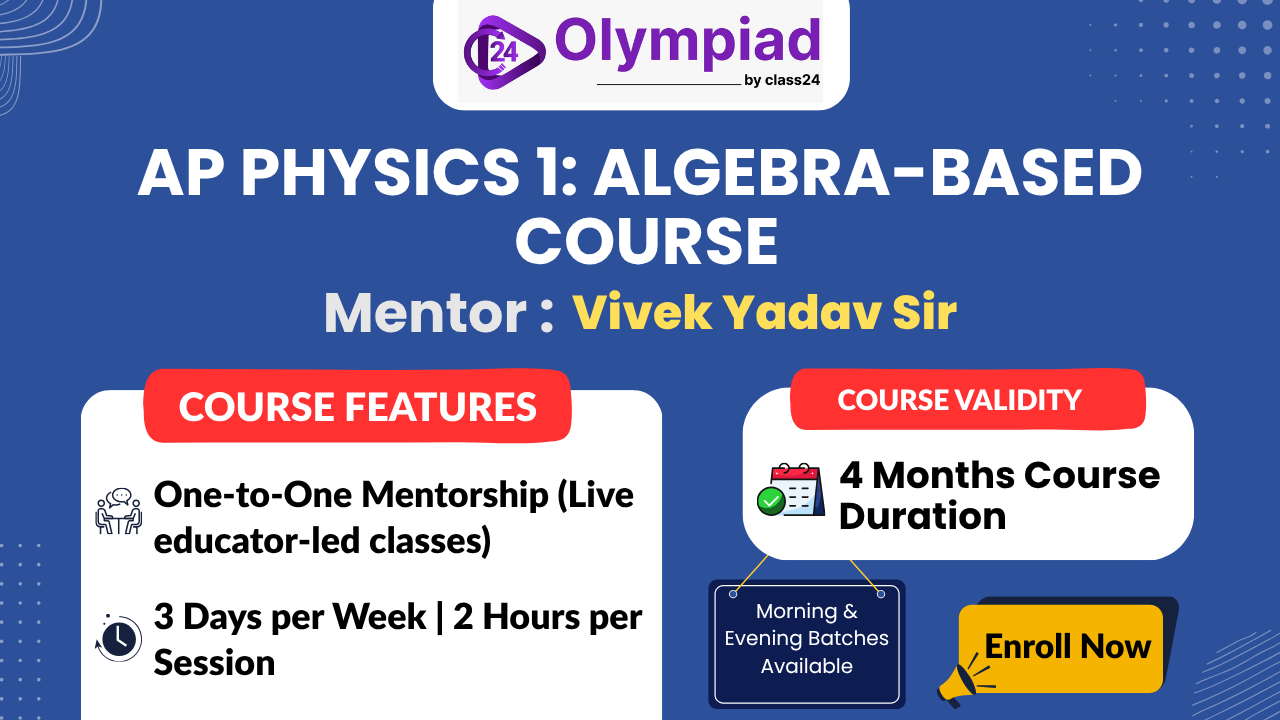
The AP Physics 1 Algebra-Based Course by Olympiad Class24 gives students four months of live, one-to-one classes with Vivek Yadav Sir. It is built for students who want to understand mechanics properly and prepare for the AP Physics 1 exam with a clear study plan.
AP Physics 1 is a first-semester, college-level physics subject that uses algebra and basic trigonometry instead of calculus. It covers motion, forces, energy, momentum, rotation, oscillations and fluids. Since the exam asks students to explain their reasoning as well as solve numerical problems, regular guided practice is very useful.
AP Physics 1 Algebra-Based Course at a Glance
The table below gives the main details of the course, including the mentor, class schedule, duration and fee, so students and parents can plan ahead.
| Detail |
Information |
| Course Name |
AP Physics 1: Algebra-Based Course |
| Offered By |
Olympiad, Class24 |
| Mentor |
Vivek Yadav Sir |
| Teaching Mode |
One-to-One Mentorship (live educator-led classes) |
| Schedule |
3 days per week, 2 hours per session |
| Course Duration |
4 months |
| Batch Timings |
Morning and evening batches available |
| Course Level |
Beginners to Advance |
| Language |
English |
| Course Fee |
Rs. 80,000 (regular price Rs. 1,00,000) |
What the AP Physics 1 Course Covers
The syllabus is divided into eight units. The course moves through them in order, because later topics such as rotation and oscillations depend on a solid base in forces and energy.
| Unit |
What Students Learn |
| Kinematics |
Describing motion with displacement, velocity and acceleration, including projectile motion and graphs |
| Force and Translational Dynamics |
Newton's laws, free-body diagrams, friction and circular motion |
| Work, Energy and Power |
Work, kinetic and potential energy, conservation of energy and power |
| Linear Momentum |
Momentum, impulse and collisions |
| Torque and Rotational Dynamics |
Torque, rotational inertia and rotational motion |
| Energy and Momentum of Rotating Systems |
Rotational energy and angular momentum |
| Oscillations |
Simple harmonic motion with springs and pendulums |
| Fluids |
Pressure, buoyancy and fluid flow |
Force and Translational Dynamics and Work, Energy and Power carry the heaviest weight on the exam, around 18% to 23% each. These two units get extra practice time in the course.
How the Live Classes Work
Every student studies in a live, one-to-one setting. This means the mentor can follow the student's thinking, spot the exact step where a mistake happens and correct it immediately.
- Three classes a week: Classes are held 3 days per week, so learning stays regular and nothing is left to the last minute.
- Two hours per session: The longer session gives time for concept teaching, worked examples and practice questions in a single class.
- Four months of preparation: The course period is enough to finish all eight units and revise them before the exam.
- Morning and evening batches: Students can pick the slot that suits their school timetable.
AP Physics 1 Exam Pattern
The exam tests both concept understanding and problem solving. Here are the main points students should know before they start preparing.
- The exam is 3 hours long and has two equally weighted sections.
- Section I has multiple-choice questions and carries 50% of the exam score.
- Section II has free-response questions and carries the other 50%.
- The exam is hybrid digital: multiple-choice questions are answered on a device, while free-response answers are handwritten in a booklet.
- A calculator is allowed in both sections.
- Scores are reported on a scale of 1 to 5.
The free-response section includes mathematical routines, translation between representations, experimental design and analysis, and qualitative or quantitative translation questions. Since question counts and timings can be updated by the College Board, students should check the official AP website for the latest details.
Common Mistakes in AP Physics 1 and How to Avoid Them
Most students lose marks for small habits, not for lack of ability. The table below lists frequent mistakes and a simple fix for each.
| Common Mistake |
How to Avoid It |
| Skipping the free-body diagram |
Draw every force on the object before using Newton's laws |
| Memorising formulas without meaning |
Explain each formula in words and say when it can be used |
| Ignoring units |
Write the unit at every step and check it at the end |
| Writing only the final answer in free-response questions |
Add one or two clear sentences to justify the answer |
| Leaving fluids for the last day |
Keep a separate revision slot for the Fluids unit |
Who Can Join the AP Physics 1 Course
The course suits high school students who want to take the AP Physics 1 exam and prefer live guidance to self-study. A prior physics course is not required, so students who are new to the subject can begin without worry. Students who already know some mechanics can use the classes to sharpen problem solving and exam writing.
Students should be comfortable with basic algebra. Since the course level is Beginners to Advance, the mentor can adjust the speed and difficulty to match each student.
Conclusion
The AP Physics 1 Algebra-Based Course offers four months of live, one-to-one mentorship with flexible batch timings. Students get clear concept teaching, regular practice and personal doubt solving in every class. Enroll now and begin your AP Physics 1 preparation with confidence.
Important Links
Explore these related AP and exam preparation resources on Olympiad Class24 to support your studies.
Frequently Asked Questions
The course is taught by Vivek Yadav Sir through live, educator-led classes in a one-to-one mentorship format.
The course runs for 4 months, with 3 classes every week and each session lasting 2 hours.
No. AP Physics 1 is algebra-based, so students need basic algebra and trigonometry. Calculus is not required for this subject.
Yes. Both morning and evening batches are available, so students can choose the timing that suits their daily schedule.
Yes. The course level is Beginners to Advance, so students can start from the basics or join for advanced practice before the exam.