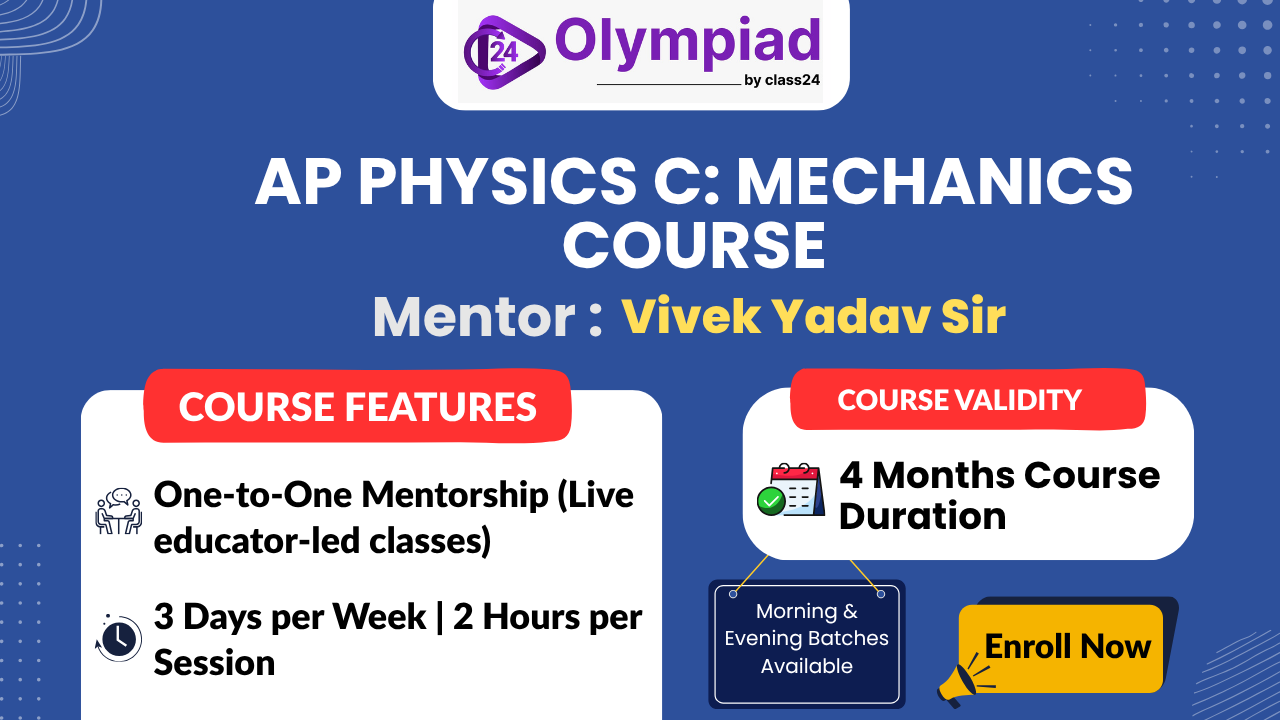
The AP Physics C Mechanics Course by Olympiad Class24 prepares students for the calculus-based AP Physics C: Mechanics exam through live, one-to-one classes with Vivek Yadav Sir. The course runs for four months and is planned for students who want to build strong problem-solving skills instead of only memorising formulas.
AP Physics C: Mechanics is equal to an introductory college mechanics course for science and engineering students. It uses calculus to describe motion, forces, energy and rotation, so students need steady practice and a mentor who can explain each derivation clearly. This course gives that support through regular live sessions.
AP Physics C Mechanics Course Details
| Detail |
Information |
| Course Name |
AP Physics C: Mechanics Course |
| Offered By |
Olympiad, Class24 |
| Mentor |
Vivek Yadav Sir |
| Teaching Mode |
One-to-One Mentorship (live educator-led classes) |
| Schedule |
3 days per week, 2 hours per session |
| Course Duration |
4 months |
| Batch Timings |
Morning and evening batches available |
| Course Level |
Beginners to Advance |
| Language |
English |
| Course Fee |
Rs. 80,000 (regular price Rs. 1,00,000) |
What Makes AP Physics C Mechanics Different
Many students compare this subject with AP Physics 1 because both deal with mechanics. The difference is the mathematics. AP Physics C: Mechanics uses derivatives and integrals, so students find velocity from position, work from a changing force and angular motion from torque using calculus methods.
The College Board suggests that students study calculus alongside this course. For many learners, the maths turns out to be harder than the physics idea itself. That is why guided practice, where every step is checked by a mentor, makes a real difference in this subject.
Units Covered in the AP Physics C Mechanics Course
The syllabus is organised into seven units. The course follows them in a logical order, so each unit builds on the one before it.
| Unit |
Main Topics |
| Kinematics |
Motion in one and two dimensions, with position, velocity and acceleration studied through derivatives and integrals |
| Force and Translational Dynamics |
Newton's laws, free-body diagrams, friction and forces that change with speed or position |
| Work, Energy and Power |
Work done by variable forces, kinetic and potential energy, conservation of energy and power |
| Linear Momentum |
Impulse, conservation of momentum, collisions and centre of mass |
| Torque and Rotational Dynamics |
Torque, moment of inertia and the rotational form of Newton's second law |
| Energy and Momentum of Rotating Systems |
Rotational kinetic energy, angular momentum and rolling motion |
| Oscillations |
Simple harmonic motion, springs and pendulums |
How the Live Classes Are Planned
The course has three classes every week, and each class lasts 2 hours. That gives students around six hours of live teaching every week. A 2-hour session is long enough to explain a concept, work through the derivation and then solve practice problems in the same class.
Four months give enough time to cover all seven units and still keep days free for revision. Morning and evening batches are available, so students can choose the timing that fits their school routine. Since the course level is Beginners to Advance, the mentor can start from the basics or move quickly to harder problems, depending on the student.
AP Physics C Mechanics Exam Pattern
Knowing the exam format early helps students plan their practice time. The AP Physics C: Mechanics exam is organised as follows.
| Feature |
Details |
| Exam Length |
3 hours |
| Section I |
Multiple-choice questions, 50% of the exam score |
| Section II |
Free-response questions, 50% of the exam score |
| Exam Format |
Hybrid digital, with multiple-choice on a device and free-response answers handwritten in a booklet |
| Calculator |
Allowed |
| Score Scale |
1 to 5 |
The free-response section includes four types of questions: mathematical routines, translation between representations, experimental design and analysis, and qualitative or quantitative translation. The College Board changes question counts and timings from time to time, so students should check the latest details on the official AP website.
Tips to Score Well in AP Physics C Mechanics
- Draw a clear diagram for every problem before writing any equation. Most errors start from a missing force or a wrong direction.
- Practise derivations by hand. Free-response questions reward students who can show how a result is obtained.
- Solve the problem with symbols first and put in numbers only at the end. This makes mistakes easier to find.
- Connect units with each other. A single question can combine energy, momentum and rotation.
- Review every wrong answer and note the reason, whether it was a concept gap, a calculus slip or a sign mistake.
Who Should Join the AP Physics C Mechanics Course
This course suits high school students who plan to take the AP Physics C: Mechanics exam and want regular live guidance. It is a good fit for students aiming at engineering or physics programmes, since the subject builds the same mechanics foundation used in college courses. It also helps students who have finished Physics 1 and want to move to a calculus-based level with a clear plan.
Conclusion
The AP Physics C Mechanics Course gives students four months of live, one-to-one mentorship with flexible batch timings. Through clear derivations, regular practice and personal doubt solving, students can build the confidence needed for the exam. Enroll now and start your AP Physics C: Mechanics preparation.
Important Links
Explore these related AP and exam preparation resources on Olympiad Class24 to support your studies.
Frequently Asked Questions
Q1. Who teaches the AP Physics C Mechanics Course?
The course is taught by Vivek Yadav Sir through live, educator-led classes in a one-to-one mentorship format.
Yes. The subject uses derivatives and integrals to explain motion, energy and rotation. The College Board suggests studying calculus alongside the course.
There are 3 classes every week, and each session lasts 2 hours. The full course runs for 4 months.
Yes. Both morning and evening batches are available, so students can choose the timing that suits their daily schedule.
India’s climatic diversity is due to variations in latitude, altitude, distance from the sea, relief features, and atmospheric factors like monsoon winds and pressure systems.